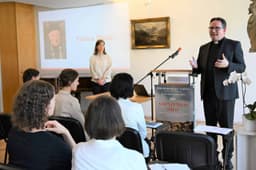
Gábor Csepregi zur Ulrich-Forschung
Die neue Beitragsreihe zur Ulrich-Forschung stellt Personen vor, die sich mit der Philosophie von Ferdinand Ulrich beschäftigen und die ihre Antworten auf die ihnen gestellten Fragen mit uns teilen. Heute kommt Gábor Csepregi aus Winnipeg in Kanada zu Wort.
Dr. Gabor Csepregi, geboren in Budapest, ist Gastdozent am St. Paul’s College der University of Manitoba in Kanada. Er war Präsident der Université de Saint-Boniface (Winnipeg) und des Dominican University College (Ottawa). Seine wissenschaftlichen Arbeiten konzentrieren sich vor allem auf die zentralen Fragen der philosophischen Anthropologie, insbesondere auf die phänomenologische Analyse von Zeit, Leib, Musik, Spiel und Bildung. Er ist Autor von „The Clever Body“, „In Vivo: A Phenomenology of Life-Defining Moments“ und „Attitudes of Play“. Sein neuestes Buch zum Thema „Encountering Presences“ wird 2026 im Verlag Mimesis International in Milano-Udine erscheinen. Er erwarb einen Master-Abschluss in Theologie und einen Doktortitel in Philosophie, beides an der Laval-Universität (Quebec City). 1976 lernte er durch Gerd Haeffner Ferdinand Ulrich in Regensburg persönlich kennen. Seine Erinnerungen an ihn hat er in seiner Autobiografie niedergeschrieben, die mit freundlicher Genehmigung des Autors auch auf unserer Website veröffentlicht wurden.
Im Folgenden die Antworten von Gábor Csepregi:
What importance do you attach to Ferdinand Ulrich’s work?
Since I have known Ferdinand Ulrich, I consider important both his person and work. He impressed me by his wide range of philosophical interests, his openness to various philosophical approaches and schools, his passion for serious reflection, his profound faith, his preference for slow progress in the elaboration of one’s ideas and critical views.
His writings on anthropological themes are, in my own work, the most inspiring: childhood, love, time, death, education, freedom, thinking in the form of constant questioning.
How did you personally find access to Ulrich’s work?
I have his books (Homo Abyssus, Gegenwart der Freiheit, Leben in der Einheit von Leben und Tod, Gebet als geschöpflicher Grundakt) and a number of offprints he has sent me. They are in my house in Winnipeg, Canada. I have here, in Budapest, with me his „Der Mensch als Anfang“. I am much looking forward to purchase his „Three Short Works“ (English translation), coming out soon.
What is the significance of Ferdinand Ulrich for your own academic work?
In my latest book „Attitudes of Play“, I relied very much on Ulrich’s reflections on childhood and, especially, on the section „Dasein als Spiel“. I will most likely turn, in the future, to his ideas on time and prayer.
Where do you think research on Ulrich could focus in the coming years?
Research could certainly focus on his metaphysics. However, in my opinion, philosophical anthropology would profit a great deal from his philosophy. His „Der Mensch als Anfang“ is a highly significant work. It deserves today a heightened attention, especially when we notice how much the various technological inventions deeply affect the lives of children and youth.
Are you interested in networking and academic exchange on Ferdinand Ulrich’s work? What do you think would be the best format (conferences, smaller online formats etc.)?
I would be interested in academic exchange on his anthropology. This exchange should focus on the relevance of his writings and not merely on the mere repetition of his chief ideas. His style makes the access to his philosophy rather difficult. It would be important to offer an easier access to his views and to show that this philosophy provides answers to the fundamental existential question: what makes human life significant and meaningful?
Conferences could offer an excellent forum for fruitful exchanges. It is important, if possible, to invite, to these events, graduate doctoral students interested in reading his publications.
Gábor Csepregi
Budapest am 29. April 2024